
Birth Is a Psychedelic Experience — And Here's the Science to Prove It
By Clare Maddalena, LushTums Founder
Let's talk about something that mainstream antenatal education almost never mentions. Something that thousands of women have experienced, that ancient cultures understood intuitively, and that modern neuroscience is only now beginning to catch up with.
Birth, at its most undisturbed and physiological, is one of the most extraordinary altered states of consciousness a human being can ever experience.
I don't mean that metaphorically. I mean it biochemically, neurologically, and — for many women — spiritually. And I believe that understanding this changes everything about how we prepare for birth, and why yoga is the single most powerful preparation tool we have.

Pregnancy yoga class practicing birth breathing and tuning inwards — LushTums
The Chemistry of Birth
Most of us know about oxytocin — the love hormone, the bond-builder, the driver of contractions. We know it rises throughout labour, peaking at the moment of birth in what the visionary obstetrician Michel Odent describes as the foetal ejection reflex — quite possibly the single biggest hormonal event of a human life.
But oxytocin is just the beginning.
In established labour, the body produces endorphins — the body's own natural opioids — in quantities that dwarf anything produced during ordinary exercise or even significant pain. These endorphins don't just reduce the intensity of sensation. They alter perception. They shift time. They can induce states of dreaming wakefulness, of deep inner absorption, of profound immersion in the present moment. Women describe being in their own world. Partners describe watching something ancient and entirely other. Midwives learn to recognise the soft, unfocused gaze of a woman who has gone deep inside herself — and they know, when they see it, that things are going well.
And then there is the piece that is perhaps the most extraordinary, and the least discussed.
Research over the past decade has identified the presence of endogenous dimethyltryptamine — DMT — in the human brain. DMT is a naturally occurring psychoactive compound found throughout the plant and animal kingdoms. It is the active ingredient in ayahuasca, the ceremonial plant medicine used for thousands of years by indigenous cultures for healing, vision and initiation. And it is produced by the human body itself — by the pineal gland and other tissues — with early research suggesting it may be released in significant quantities at moments of profound physiological intensity.
Including, it appears, at birth.
We want to be clear: this research is still emerging, and we are not making definitive clinical claims. But the convergence of evidence from neuroscience, biochemistry, and the reported experiences of thousands of birthing women across cultures and centuries is striking. Birth, at its most undisturbed, appears to be a genuinely psychedelic experience.
Not psychedelic in a recreational sense. Psychedelic in the original meaning of the word. Psyche — mind. Delos — to reveal, to make manifest. Birth, when we get out of its way, appears to reveal something. Something ancient. Something real. Something our bright-lit, clipboard-carrying, intervention-ready culture has been progressively obscuring.
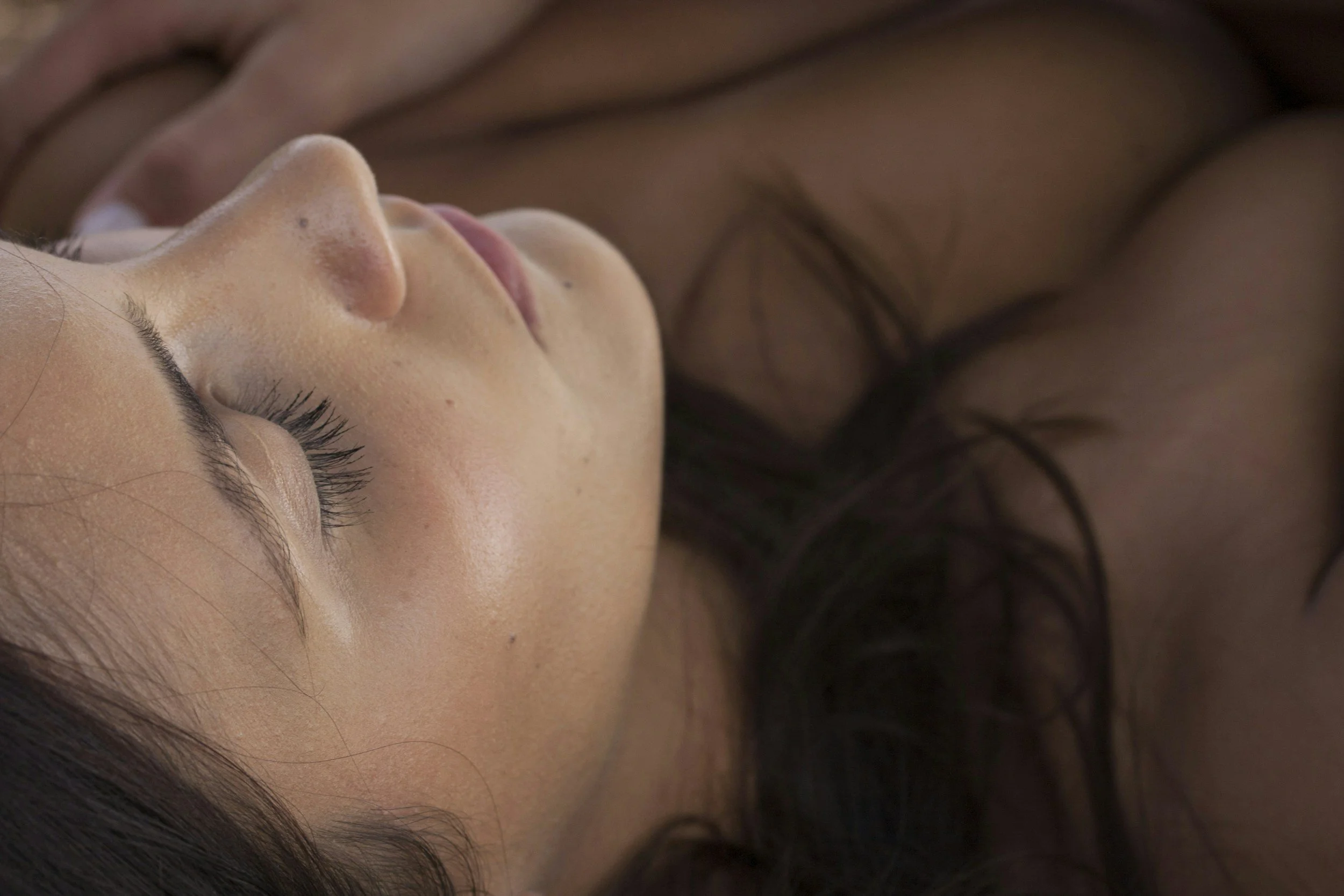
Woman in altered state during labour — the hormonal landscape of birth
The Problem
Here is the thing. This extraordinary altered state — this endorphin-soaked, oxytocin-flooded, potentially DMT-touched experience — is one that most women in the modern world have absolutely no frame of reference for.
They have never felt anything like it. They have no map. No language. No felt sense of what it means to let the thinking brain go quiet and allow the body to take completely over.
And so when it begins to happen — when the frontal cortex starts to soften, when the boundaries of ordinary consciousness begin to dissolve, when the world starts to feel vast and close and primal and strange all at once — many women panic. They interpret the altered state as something going wrong. They reach for an anchor in rational thought. And in doing so, they activate the one thing that can genuinely slow or stall the birth process: fear.
Fear triggers adrenaline. Adrenaline inhibits oxytocin. Contractions weaken or space out. Pain intensifies. The body, which was doing exactly what it was designed to do, suddenly feels like the enemy.
This is not women failing at birth. This is women encountering something they were never prepared for.
If you want to understand more about how fear affects the physiology of labour, Dr Rachel Reed's work is essential reading — she writes with extraordinary clarity about the hormonal landscape of undisturbed birth and why the conditions we create around a labouring woman matter so profoundly.
Why Yoga Is the Only Rehearsal
This is where I want to say something that I have felt to be true for nearly twenty years of teaching pregnancy yoga, and which science is now beginning to illuminate.
The meditative, deeply embodied state we access in yoga practice is, neurologically and biochemically, a rehearsal for labour.
When we breathe slowly and the thinking mind goes quiet — when a woman stops planning tomorrow's to-do list and simply becomes the breath and the movement — she is accessing a state in which the frontal cortex softens, the default mode network reduces its chatter, and the more ancient, feeling, instinctive parts of the brain come forward.
This is a mild form of the same shift in consciousness that occurs in established labour.
The slow, rhythmic movement of all-fours circles activates the same neural pathways that rhythmic pelvic movement activates in birth. The long exhale of the golden thread breath stimulates the same vagal response that deepens the birthing trance. The warmth, the dim lighting, the gentle holding of the hello circle — all of this creates conditions in which something more ancient and trustworthy than our thinking minds begins to come through.
The neuroscientist Stephen Porges, whose Polyvagal Theory has transformed our understanding of the nervous system, describes this as activating the ventral vagal pathway — the state of calm, connected, open presence that is optimal not just for wellbeing, but for birth itself. Slow rhythmic movement, gentle sound, warm social connection — all of which are embedded in every LushTums class — directly stimulate this pathway. This is not accidental. This is design.
We can say to our students — and mean it completely — that every time they come to class and allow themselves to truly arrive, to stop thinking and start feeling, to drop into that quiet, vast, present place — they are practicing for birth. They are building a neural pathway. They are telling their nervous system: this altered state is safe. I know how to be here. My body knows what to do.
This is not wishful thinking. It is neuroscience.
What This Means for Birth Preparation
If birth is an altered state — and the evidence suggests it is — then the most important thing we can do to prepare for it is practice being in altered states. Not frightening ones. Not overwhelming ones. The gentle, warm, breath-led, movement-supported altered state of a pregnancy yoga class. The quiet that settles over a room full of pregnant women twenty minutes into a class. The place between waking and sleeping that opens in savasana. The moment during yoga nidra when the body melts and the mind goes still and there is simply presence.
These are not indulgences. They are not extras. They are the whole point.
When a woman has visited that quiet, trusting, inward place week after week throughout her pregnancy — when her body knows the feeling of letting go and has found it safe, again and again — she is far more likely to be able to find it in labour. Not because she thinks her way there. Because her body already knows the way.
This is what we are building in our classes. This is what LushTums has always been about, even before we had the language to explain why.
For those who want to go deeper into the science, Bessel van der Kolk's The Body Keeps The Score offers a profound exploration of how the body holds and processes experience — essential reading for anyone working with women in pregnancy and birth. And Ina May Gaskin's Spiritual Midwifery remains, after fifty years, the most beautiful and honest account of what birth looks and feels like when women are truly supported to let go.
And this is why, if I could say one thing to every pregnant woman preparing for birth, it would be this:
Your body is not just capable of birth. It is designed for it, right down to its chemistry. It will take you somewhere ancient and extraordinary. Practice getting out of the way — and trust where it leads.
Want to experience this for yourself?
If you're pregnant and looking for pregnancy yoga classes that prepare you not just physically but neurologically and hormonally for birth, find your nearest LushTums teacher at lushtums.co.uk.
And if you're a yoga teacher inspired by this approach and want to learn how to teach it, our Pregnancy Yoga Teacher Training is open for enrolment. We go deep — into the science, the philosophy, the biomechanics and the biochemistry of birth — because we believe that pregnancy yoga teachers deserve to understand why what they do works, as much as how to do it.
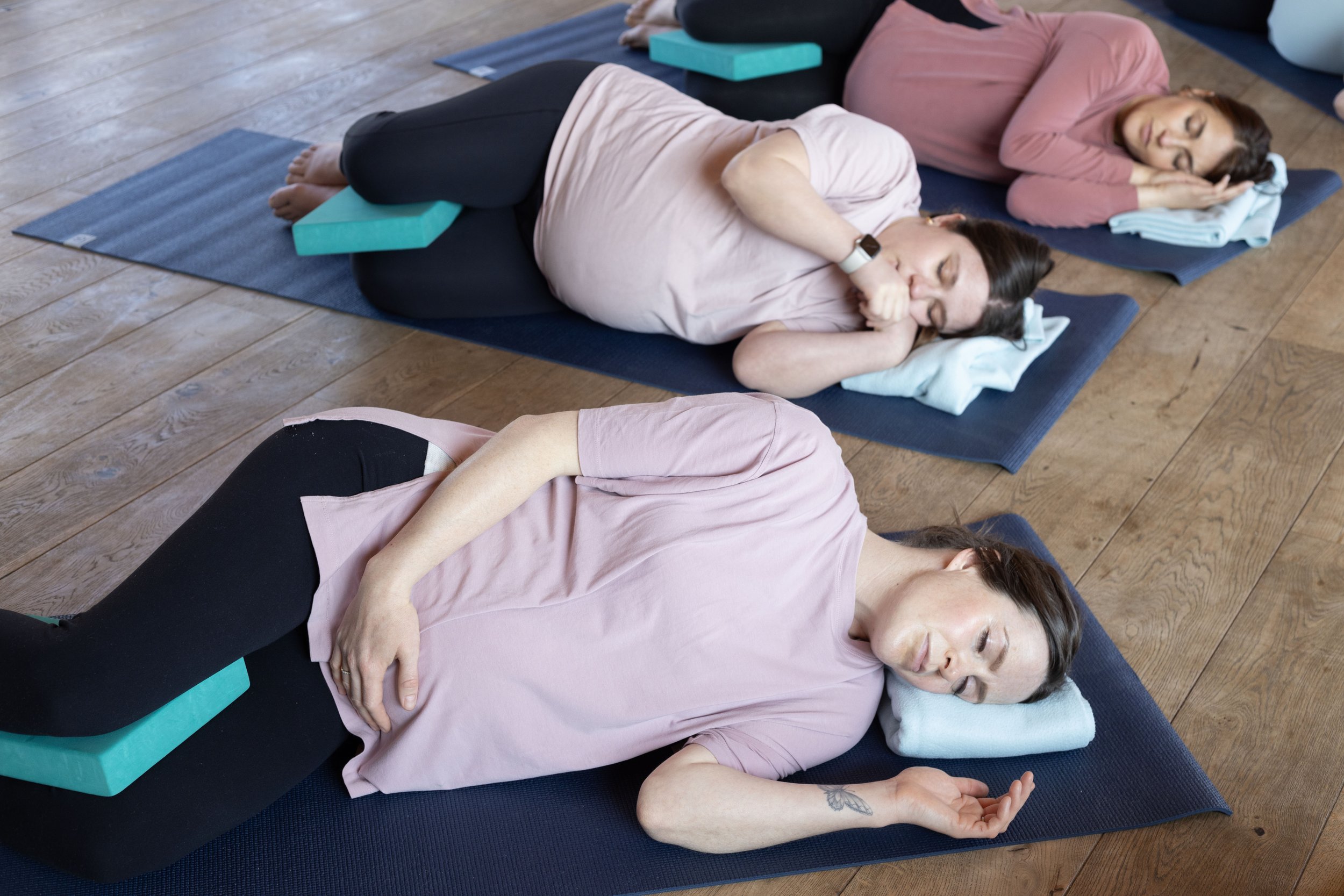
Pregnant woman in yoga nidra relaxation — rehearsing the altered state of birth
Subscribe to our newsletter below to keep in touch and hear about all our latest blog updates.
Clare Maddalena is the founder of LushTums and a Senior Yoga Teacher, Doula and Antenatal Educator with nearly twenty years of experience working with pregnant women and new mothers. LushTums Pregnancy Yoga Teacher Training is open for enrolment — visit lushtums.co.uk to find out more.